Do You Recognize the 5 Warning Signs of a Dead Sale?

Preoccupied, worried young male worker staring at computer

Time management is the salesperson’s toughest challenge. It’s crucial that you spend the majority of your time on projects that will yield results. In my article How to Cut Your Workload and Increase Sales, I teach you how to prioritize your quotation log for maximum benefits. A key piece of this mindset is knowing when to walk away from a sale that has already been lost.

Since even a seasoned salesperson can find themselves wasting time on a dead sale, I discuss the five most common symptoms below:

  1. You find yourself thinking that you’ve invested so much time and energy in a quotation that you can’t possibly stop now. You have no choice but to follow through until the bitter end.

    This happens more often than you think: a salesperson fooling themselves into believing there’s still a chance of landing a dead sale. After all, it’s hard to admit defeat when you’ve put a lot of effort into a sale. However, the cold hard fact is spending countless hours on a project does not guarantee results. At some point, you will have to realize that you have lost your objectivity. Don’t make the mistake of looking at the same quotation two months from now and realizing you’ve spent even more time and money on it.

    Instead, ask for an impartial opinion. Sit down with your manager or coworker and discuss what’s going on. If all evidence points to a situation where you are continuing to work on a case just because you’ve already sunk so much energy into it, it may be time to stop and move on to the next case.

  2. The customer has given countless deadlines for when a decision will be made, but they never materialize. It’s always next month, next quarter, next year.

  3. The customer’s organization around the quote hasn’t changed for awhile. It may seem like your contact is working alone on this project.

    If a customer is ramping up to make a purchase, it’s normal to receive input from multiple disciplines within the organization: purchasing, engineering, IT, manufacturing. If you’ve been dealing with one person only on a quote that never seems to come to an order, someone may be using you to fill their time, justify their position, etc.

    Every now and then, you will come upon a customer who asks for a quote just to keep busy, and it’s only after some digging that you can see whether the request is coming from the customer’s organization or from an individual. Unfortunately, there’s no way of knowing this when you receive a quote request.

  4. The customer doesn’t have firm advice about how to revise your quote, and you get a feeling of non-committal or even carelessness toward your quotation.

    A customer buys because they have a need. They are looking for the best solution to a problem. Because of this, if you keep yourself in good standing, they are willing to discuss your quotation and give you suggestions for making it better. If this process stops and they still haven’t placed an order with someone, there is a high likelihood that you have not been a serious contender from the get-go, or they probably won’t. Unfortunately, sometimes a customer’s employees make plans that do not yet have financial backing. In other words, this project could be in the very initial planning phase.

  5. It seems the customer keeps asking for dramatic changes, which do not seem to make sense to you at this phase of the project. The project never reaches a critical point where the order is placed.

    The customer keeps calling to ask for radical revisions to your quote. You scramble to put them together and submit the new numbers and specs, but again, the customer doesn’t place an order with anyone.

Both scenarios in (4) and (5) should signal to the salesperson that the project is not a priority to the customer, or that the person you are dealing with is not the right person to begin with. You may be dealing with internal disagreements about how to proceed, if a purchase is necessary, budget constraints or lack of budget, or a change in customer personnel. The point is the customer will most likely not order in the near future, and you shouldn’t be spending your time like they will. This doesn’t mean they’ll never place the order, just maybe not in the very near future. You can still work on the quote, but don’t put so much time and resources into it.

As always, keep a positive attitude and don’t burn any bridges. You’re in this for the long haul, and relationships are important. Your graciousness may be rewarded in the future.

Did you like this article? Sign up below to receive updates in your inbox.

Posted in Uncategorized | Leave a comment

Why Businesses Fail

DSCN4117

In September of 2013, Eric T. Wagner published an article in Forbes-magazine[1] detailing five reasons why eight out of ten businesses fail.

  1. Businesses are not really in touch with customers through deep dialogue
  2. There is no real differentiation in the market (lack of unique value propositions)
  3. The failure to communicate value propositions in clear, concise, and compelling fashion
  4. Leadership breakdown at the top of the organization (founder dysfunction)
  5. The inability to nail a profitable business model with proven revenue streams

Every one of these points has a common denominator: they are all related to sales, sales skill, and sales success. Here are my five reasons why businesses fail:

  1. Running out of money before the business takes off. Many times a business that fails simply ran out of money, period!
  2. Not reaching the potential customer base. This really has nothing to do with being in touch with customers because in order to be in touch with customers, one needs to have customers. I am talking about potential customer not knowing you exist. A solid tip on how to recognize a customer: it is the one who places an order with you.
  3. Not pricing goods or services properly, causing an inability to close potential sales. There are potential customers for every company, but offerings must be aligned with the price that those potential customers are willing and capable of paying.
  4. Hiring the wrong type salespeople. This is by far your biggest challenge as a business owner or department manager. Your sales people are an extension of you and your company, and they must act like it. A “wrong” salesperson can create an enormous amount of bad will and a poor reputation.
  5. Not training your salespeople properly. Big corporations can afford to hire people with no experience or with limited experience, small business can’t.

A good salesperson is much more valuable than they often get credit for. If you are in a sales management role, I would urge you to take a look at your sales force today and see how you can help them achieve greater results.

[1] http://www.forbes.com/sites/ericwagner/2013/05/23/5-key-business-model-components/

Posted in Uncategorized | Leave a comment

What is Sales Intelligence?

Trinity Hancock blue

In Wiki, Sales Intelligence is defined like this: Sales intelligence (SI) refers to technologies, applications and practices for the collection, integration, analysis, and presentation of information to help salespeople keep up to date with clients, prospect data, and drive business.

A Google search of sales intelligence makes it clear that numerous companies produce software to collect this data. This software is at its best analyzing and staticizing (yeah, that’s a word!) large amounts of information. For example, it works well if you are a salesperson responsible for analyzing customer behavior on heavily visited sites. When records exceed tens or hundreds of thousands, the only way to really draw conclusions is by having AI work on your SI to bring the highest amount of ROI.

But, there is always a but. What if you are a small business owner that makes 100 sales per month? What if you are a specialty equipment or service seller who makes 15 quotes per week, and lands an average of 3 of them? In these cases, statistical tools are just about useless.

With small data samplings, you are not going to get answers like this: It is the 27th of the month. You are writing your 16th proposal for the month, and you have received 6 orders already this month from 15 previous quotes. Statistically speaking, you will not get this order. So, does that mean you shouldn’t quote? No, of course you should quote!

I am convinced that specialty products, small businesses, low-volume, high-priced, and some other product and service categories will not be able to effectively utilize ASI (Artificial Sales Intelligence). In the rush to embrace technology, there is the danger of relying too much on that technology alone. Remember the old saying about fire? It is a good assistant when carefully controlled, but a terrible master.

The fact is companies still need good salespeople on the front lines who can think on their feet. Every quote is decided by a person or group of buyers. Knowing that, statistically, you will win every fifth quote is great, but how does that information help you with the customer you are working with now?

Click on the Follow button below to receive updates in your inbox!

Posted in Uncategorized | Leave a comment

Sales Intelligence: Identifying the Whisperer

Purchasing a large project is rarely decided by one person. The evaluation and decision making process is almost always the effort of a team of representatives from different disciplines within the customer’s organization; e.g. finance, IT, engineering, and manufacturing. As a salesperson to a new company, it’s difficult to know which discipline has more vendor or product selection power than others. And, it may appear that your main contact has the organizational power to decide the outcome of a vendor selection, but most likely they do not hold sole power.

Each organizational discipline has powerful advisors behind the scenes: the whisperers. Whisperers have many names. Some people call them stakeholders, or influencers. Whisperers covertly lean on perceived decision makers, and can affect the outcome of a purchase without anyone outside the company even knowing they are part of the decision making process.

Whisperers choose to not make it known that they have a significant say in the purchasing decision. Therefore, the salesperson must always be aware of the folks residing on the outskirts of the buying process. Most times they will not see or meet the whisperer, and if they do, the whisperer certainly doesn’t come right out and say, “Hi, my name is Joe, and I am a whisperer on this project.” On the contrary, they may slip into a meeting or product presentation casually late enough to miss the introductions, sit in the back row, and leave so quickly afterwards that the salesperson never really gets a chance to shake their hand.

Sometimes a whisperer is easy to identify. When they talk, no one in the customer’s organization disagrees with their opinion. However, some whisperers are not so easy to pinpoint. Maybe it’s the quiet one; the one not looking for vendor respect or recognition. Or, they can be someone you didn’t even think about.

Let’s say a trucking company is looking to purchase new vehicles. A walk around their lot confirms that the company owns 35 Big Brand trucks. Due to a lack of resources, the maintenance department works a lot of overtime keeping the fleet in good condition. The maintenance supervisor may lean heavily on the project team to persuade them to buy only Big Brand. His reasoning is that the mechanics already know how to service Big Brand trucks and won’t need additional training. They also keep an inventory of spare parts for Big Brand. Buying a new brand means buying and stocking additional spare parts, and probably training. “Whose budget will pay for it?” he asks, “Not mine.”

In this situation, the maintenance supervisor wields influence over the perceived decision makers with the fear of recurring unknown future costs (additional labor, training, and spare parts) versus a fixed one-time truck purchase cost. If you are selling a different brand vehicle, you need to know this so you can effectively address these issues in your bid. Otherwise, you may find yourself back at your desk wondering how on earth you lost the sale.

It’s all about positive cash flow, and cash flow is affected by many variables. In the case above, a few things can happen.

  • You don’t know about the maintenance whisperer, and head into the bidding process with the lowest price and the best service, and still lose the sale.
  • You probe the customer organization, ask the right questions, and find out about the maintenance supervisor’s objections to buying your product. Since you know about him, you are able to respond appropriately before you lose the sale. Maybe your company will offer spare parts on consignment, or establish a spare parts inventory close by, or take a one-time hit on training the customer’s maintenance personnel. (Remember, there’s probably a finance or purchasing whisperer whose main priority is cost. If you can offer a fantastic deal including service and training and still come in under the competitor’s price you have a good chance of turning this whisperer in your favor.)

I once visited a large European truck manufacturing unit where we were quoting a highly automated production line. We had three brand name robots in stock, and our installation personnel had already been trained. Our quote reflected this, and I had a good feeling we could win the project based on price. Later, I was walking through the customer’s plant and discovered that they were using the same brand of robot throughout the plant, and it was different than the brand we had quoted. A conversation with the head of production did, indeed, confirm that they only used one kind. “And,” he added, “we will not buy anything else.” He went on to tell me how the robot supplier was integrated into their plant and had been contracted to provide onsite maintenance services, and I realized that I had found one of the biggest whisperers on this project. Luckily, it wasn’t too late to change the robot manufacturer in our quote, and we did land the sale.

A salesperson should try to identify as many whisperers as early on as possible. Map out the customer organization. One of your first questions should be, “Which departments will be involved in the product selection?” Then, do your homework and find out who the powers behind the curtain are. Ask a lot of well-placed questions so you know which features or components of the sale are important to each one – delivery is probably important to the manufacturing whisperer and price may be the main motivator for a finance or purchasing whisperer. Make sure your quote answers those needs. Finally, find out their position on each supplier, and do your best to influence them to not be against your product or company.

Every time a salesperson works with a customer, it’s a safe bet to assume there are whisperers. The bigger and more significant a project, the more whisperers there are, and not all of them are motivated by the same issues.

Posted in Uncategorized | Tagged , , | Leave a comment

What is Sales Risk Management?

business concept

Sales Risk Management is identifying, quantifying, and mitigating risk found in the sales process. It is, perhaps, one of the most underutilized sales tools. Not only does Sales Risk Management protect profits, it also helps build and protect long term customer relationships.

Most businesses do not recognize the risks of a sale. And, even if they do identify risks, they don’t understand how to mitigate those risks and don’t utilize mitigation methods.

The most obvious area of mitigation is contracts. Most managers and salespeople believe this is the realm of the lawyer, and not really their responsibility. Sales Risk cannot be controlled by sliding a contract across the table to a lawyer. A lawyer may know the legal aspects of a contract, but good contracts are built on business; product; and industry knowledge, experience, and practices.

Contracts are very important. However, they are not the end-all to Sales Risk Management. The sales process includes six steps:

  • Information gathering and analysis
  • Understanding and reading a customer
  • Offering the right product at the right price
  • Communicating in a way that leaves the customer with no doubts about you, your product, or your company
  • Executing a contract
  • Follow up (Delivery, Installation, Documentation)

Each step carries its own inherent risk. Some might not seem connected at all: a blunder in documentation or the receptionist being rude to your customer during a sensitive negotiation and they decide your company is not for them (and you don’t know why).

These risks grow exponentially when a company starts conducting business outside its home country. How will subcontracting and transportation be handled? What kind of obstacles or misunderstandings will be caused by language? What laws, where, and who will resolve potential disputes?

Click the Follow button below to receive updates in your inbox.

Posted in Uncategorized | Leave a comment

Sales Tips From Timo: Start With the Need

Your job as a salesperson is to convince customers to order from you. This doesn’t mean you just make phone calls and write quotations; it means you make phone calls, write quotations, and engage in customer interactions that turn into profitable orders.

So, how do you do that? And, what if you feel you’ve been doing everything you can, but still aren’t seeing results? Read on.

The first thing you need to do is understand your product and service features, and who is your target customer. I can see the eye rolls and hear the “duh’s” through the screen, but bear with me.

Every sale begins with a need. Period. No need, no sale. Take a closer look at the sales you’ve lost.

  1. What was the customer’s need?
  2. Did your product fill that need?

Is your product a great solution to the customer’s problem, or are you trying to twist the situation around and make the customer’s need fit your product? There is a difference, so be brutally honest with yourself. Did the project look something like this?

Customer Wants vs Your Product

If this is the case, your chances of getting that sale were slim even before quoting it.

Let’s say your company sells 50-gallon water heaters, and you hear of a contractor that is looking to buy water heaters for his new housing development. You get your hands on a copy of the specs, which call for wall mounted tankless water heaters because this guy specializes in energy efficient houses. You know the guy needs water heaters and he’s going to buy water heaters to fill that need. Hey, you sell water heaters. They aren’t exactly the same, but they’ll get the job done. If you can just talk to the guy, you know you can convince him to switch his specs …

If you spend all your time on projects like this one, you will have a hard time meeting your quota. Always remember that time is the salesperson’s most valuable commodity. It’s tempting to quote everything that moves, but not every customer is for you, your product, or for your company. You need to analyze every customer and decide if they are part of your target market – the ones most likely to order from you. Time you spend on a low probability customer is time away from another customer with a higher probability of an order. Pay attention to those customers that you are better suited to serve, that your product is proven to be right for them, and you can be competitive.

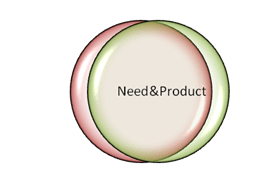
However, if the project looks like this; then, you should have a great chance of landing the sale.

Customer Need and Your Product

If you don’t, and this one ends up in the folder of disappointments as well, something else went wrong.

Posted in Uncategorized | Leave a comment